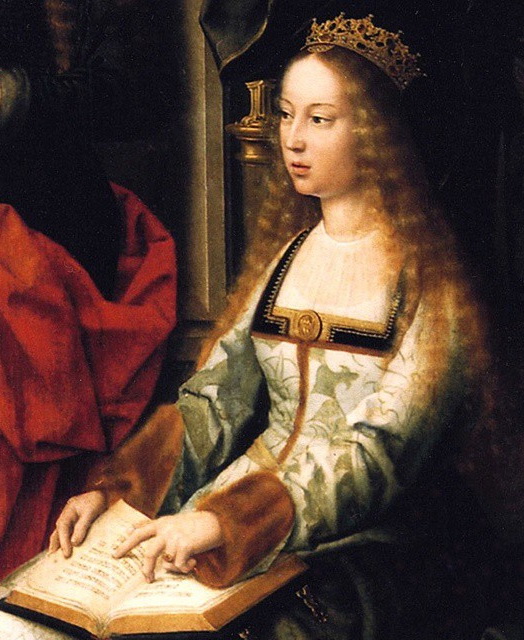
Isabella I (Spanish: Isabel I, Old Spanish: Ysabel I; 22 April 1451–26 November 1504) was Queen of Castille. She was married to Ferdinand II ofAragon. Their marriage became the basis for the political unification of Spain under their grandson, Holy Roman Emperor Charles V. After a struggle to claim her right to the throne, she reorganized the governmental system, brought the crime rate to the lowest it had been in years, and unburdened the kingdom of the enormous debt her brother had left behind. Her reforms and those she made with her husband had an influence that extended well beyond the borders of their united kingdoms. Isabella and Ferdinand are known for completing the Reconquista, ordering conversion or exile of their Muslim and Jewish subjects in the Spanish Inquisition, and for supporting and financingChristopher Columbus' 1492 voyage that led to the opening of the New Worldand to the establishment of Spain as the first global power which dominated Europe and much of the world for more than a century. Isabella was granted the title Servant of God by the Catholic Church in 1974.
sabella was born in Madrigal de las Altas Torres, Ávila, to John II of Castile andIsabella of Portugal on 22 April 1451.[1] At the time of her birth, she was second in line to throne after her older half-brother Henry. Henry was 26 at that time and married but childless. Her younger brother Alfonso was born two years later on 17 November 1453, lowering her position to third in line.[2] When her father died in 1454, her half-brother ascended to the throne as Henry IV. Isabella and Alfonso were left in Henry's care.[3] She, her mother and her brother Alfonso then moved to Arévalo.[4]
These were times of turmoil for Isabella. Living conditions in their castle in Arévalo were poor, and they suffered from a shortage of money. Although her father arranged in his will for his children to be financially well taken care of, Henry did not comply with their father's wishes, either from a desire to keep his half-siblings restricted or from ineptitude.[3] Even though living conditions were lackluster, under the careful eye of her mother, Isabella was instructed in lessons of practical piety and in a deep reverence for religion
When the King's wife, Joan of Portugal, was about to give birth to their daughter Joanna, Isabella and Alfonso were summoned to court (Segovia) to come under the direct supervision of the King and to finish their education. Alfonso was placed in the care of a tutor while Isabella became part of the Queen's household
Some of Isabella's living conditions improved in Segovia. She always had food and clothing and lived in a castle that was adorned with gold and silver. Isabella's basic education consisted of reading, spelling, writing, grammar, mathematics, art, chess, dancing, embroidery, music, and religious instruction. She and her ladies-in-waiting entertained themselves with art, embroidery, and music. She lived a relaxed lifestyle, but she rarely left Segovia as Henry forbade this. Her half-brother was keeping her from the political turmoils going on in the kingdom, though Isabella had full knowledge of what was going on and of her role in the feuds.
The noblemen, anxious for power, confronted King Henry, demanding that his younger half brother Infante Alfonso be named his successor. They even went so far as to ask Alfonso to seize the throne. The nobles, now in control of Alfonso and claiming that he was the true heir, clashed with Henry's forces at the Second Battle of Olmedo in 1467. The battle was a draw. Henry agreed to recognise Alfonso as heir presumptive, provided that he would marry his daughter, Joanna.[6] Soon after he was named Prince of Asturias, Alfonso died in July 1468, likely of the plague. The nobles who had supported him suspected poisoning. As she had been named in her brother's will as his successor, the nobles asked Isabella to take his place as champion of the rebellion. However, support for the rebels had begun to wane, and Isabella preferred a negotiated settlement to continuing the war.[7] She met with Henry and, at Toros de Guisando, they reached a compromise: the war would stop, Henry would name Isabella his heir-presumptive instead of Joanna, and Isabella would not marry without Henry's consent but he would not be able to force her to marry against her will.[8] Isabella's side came out with most of what they desired, though they did not go so far as to officially depose Henry: they were not powerful enough to do so, and Isabella did not want to jeopardise the principle of fair inherited succession, since it was upon this idea that she had based her argument for legitimacy as heir-presumptive.
Marriage
The question of Isabella's marriage was not a new one. Indeed, she had made her debut in the matrimonial market at the tender age of six, with a betrothal to Ferdinand, the younger son of John II of Navarre (whose family was a cadet branch of the House of Trastámara). At that time, the two kings, Henry and John, were eager to show their mutual love and confidence and they believed that this double alliance would make their eternal friendship obvious to the world.[9] This arrangement, however, did not last long.
In 1465 an attempt was made to marry Isabella to Alfonso V of Portugal, Henry's brother-in-law. Through the medium of the Queen and Count of Ledesma, a Portuguese alliance was made.[12] Isabella, however, was wary of the marriage and refused to consent.[13]
A civil war broke out in Castile over King Henry's inability to act as sovereign. Henry now needed a quick way to please the rebels of the kingdom. As part of an agreement to restore peace, Isabella was to be betrothed to Pedro Girón Acuña Pacheco, Master of the Order of Calatrava and brother to the King's favourite, Juan Pacheco.[12] In return, Don Pedro would pay into the impoverished royal treasury an enormous sum of money. Seeing no alternative, Henry agreed to the marriage. Isabella was aghast and prayed to God that the marriage would not come to pass. Her prayers were answered when Don Pedro suddenly fell ill and died while on his way to meet his fiancée.[12][14]
When Henry recognised Isabella as his heir-presumptive on 19 September in 1468, he also promised that his sister should not be compelled to marry against her will, while she in return agreed to obtain his consent.[8] It seemed that finally the years of failed attempts at political marriages were over. There was talk of a marriage to Edward IV of England or to one of his brothers, probably Richard, Duke of Gloucester,[15] but this alliance was never seriously considered.[8] Once again in 1468, a marriage proposal arrived from Alfonso V of Portugal. Going against his promises made in September, Henry tried to make the marriage a reality. If Isabella married Alfonso, Henry's daughter Joanna would marry Alfonso's son John II and thus, after the death of the old king, John and Joanna could inherit Portugal and Castile.[16] Isabella refused and made a secret promise to marry her cousin and very first betrothed, Ferdinand of Aragon.
War with Portugal
Isabella's reign got off to a rocky start. Because her brother had named Isabella as his successor, when she ascended to the throne in 1474, there were already several plots against her. Diego Pacheco, the Marquis of Villena, and his followers maintained that Joanna, daughter of Henry IV, was the rightful queen.[22] Shortly after the Marquis made his claim, a longtime supporter of Isabella, the Archbishop of Toledo left court to plot with his great-nephew the Marquis. The Archbishop and Marquis made plans to have the Infanta Joanna marry her uncle, King Alfonso V of Portugal and invade Castile to claim the throne for themselves
In May 1475, Alfonso and his army crossed into Spain and advanced to Plasencia. Here he married the young Joanna.[24] A long and bloody war for the Castilian succession then took place. The war went back and forth for almost a year until 1 March 1476 when the Battle of Toro took place, a battle in which both sides claimed victory[25][26] and celebrated[26][27] the victory: the troops of Afonso V were beaten[28][29] by the Castilian centre-left commanded by the Duke of Alba and Cardinal Mendoza while the forces led by Prince John of Portugal defeated[30][31][32][33] the Castilian right wing and remained in possession[34][35] of the battlefield

No comments:
Post a Comment