/////////////////////
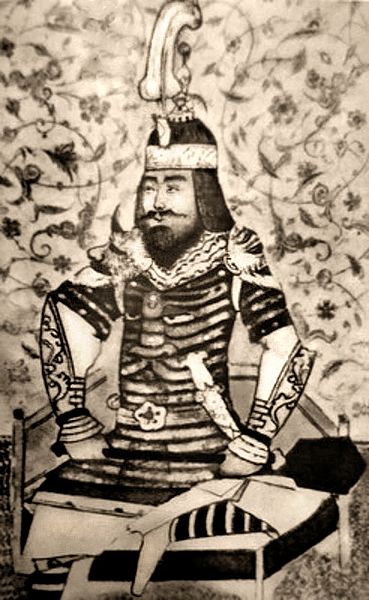
Timur (Persian: تیمور Timūr, Chagatai: Temür, Uzbek: Temur; 9 April 1336— 18 February 1405), historically known as Tamerlane[2] (Persian: تيمور لنگ Timūr(-e) Lang, "Timur the Lame"), was a Turco-Mongol conqueror and the founder of the Timurid Empire in Persia and Central Asia.[3] He was also the first ruler in the Timurid dynasty.
Timur envisioned the restoration of the
Mongol Empire of
Genghis Khan. "In his formal correspondence Temur continued throughout his life to portray himself as the restorer of
Chinggisid rights. He justified his Iranian, Mamluk and Ottoman campaigns as a re-imposition of legitimate Mongol control over lands taken by usurpers
[6] To legitimize his conquests, Timur relied on Islamic symbols and language, referred to himself as the "Sword of Islam" and patronized educational and religious institutions. He converted nearly all the
Borjigin leaders to
Islam during his lifetime. "Temur, a non-Chinggisid, tried to build a double legitimacy based on his role as both guardian and restorer of the Mongol Empire."
[7] Timur also decisively defeated the Christian
Knights Hospitaller at
Smyrna, styling himself a
ghazi.
[8]:91 By the end of his reign, Timur had gained complete control over all the remnants of the
Chagatai Khanate,
Ilkhanate, and
Golden Horde and even attempted to restore the
Yuan dynasty.
[citation needed]
Timur's armies were inclusively multi-ethnic and were feared throughout Asia, Africa, and Europe,
[8] sizable parts of which were laid waste by his campaigns.
[9] Scholars estimate that his military campaigns caused the deaths of 17 million people, amounting to about
5% of the world population.
[10][11]
He was the grandfather of the renowned Timurid sultan, astronomer and mathematician
Ulugh Beg, who ruled Central Asia from 1411 to 1449, and the great-great-great-grandfather of
Babur, founder of the
Mughal Empire, which ruled parts of
South Asia for over three centuries, from 1526 until 1857.
[12][13]Timur is also recognized as a great patron of art and architecture, as he interacted with
Muslim intellectuals such as
Ibn Khaldun and
Hafiz-i Abru.
Later Timurid dynastic histories claim that he was born on April 8, 1336, but most sources from his lifetime give ages that are consistent with a birthdate in the late 1320s. Historian
Beatrice Forbes Manz suspects the 1336 date was designed to tie Timur to the legacy of
Abu Sa'id Bahadur Khan, the last ruler of the
Ilkhanate descended from
Hulagu Khan, who died in that year.
[23]
At the age of eight or nine, Timur and his mother and brothers were carried as prisoners to Samarkand by an invading Mongol army. In his childhood, Timur and a small band of followers raided travelers for goods, especially animals such as sheep, horses, and cattle.
[23]:116 In around 1363, it is believed that Timur tried to steal a sheep from a shepherd but was shot by two arrows, one in his right leg and another in his right hand, where he lost two fingers. Both injuries crippled him for life. Some believe that Timur suffered his crippling injuries while serving as a mercenary to the khan of
Sistan in
Khorasan in what is today the
Dashti Margo in southwest
Afghanistan. Timur's injuries have given him the names of Timur the Lame and Tamerlane by Europeans.
[8]:31
Timur was a Muslim, possibly belonging to the
Naqshbandi school of Sufism, which was influential in Transoxiana.
[24]However, his chief official religious counsellor and adviser was the
Hanafi scholar 'Abdu 'l-Jabbar Khwarazmi. In Tirmidh, he had come under the influence of his spiritual mentor
Sayyid Baraka, a leader from
Balkh who is buried alongside Timur in
Gur-e-Amir.
[25][26][27] Timur was known to hold
Ali and the
Ahl al-Bayt in high regard and has been noted by various scholars for his "pro-
Alid" stance. Despite this, Timur was noted for attacking the Shia with Sunni apologism
Timur is regarded as a military genius, and as a brilliant tactician with an uncanny ability to work within a highly fluid political structure to win and maintain a loyal following of nomads during his rule in Central Asia. He was also considered extraordinarily intelligent – not only intuitively but also intellectually.[5]:16 In Samarkand and his many travels, Timur, under the guidance of distinguished scholars, was able to learn the Persian, Mongolian, and Turkic languages.[8]:9 More importantly, Timur was characterized as an opportunist. Taking advantage of his Turco-Mongolian heritage, Timur frequently used either the Islamic religion or the law and traditions of the Mongol Empire to achieve his military goals or domestic political aims
About 1360 Timur gained prominence as a military leader whose troops were mostly Turkic tribesmen of the region.
[20] He took part in campaigns in
Transoxiana with the Khan of the Chagatai Khanate. Allying himself both in cause and by family connection with Kurgan, the dethroner and destroyer of
Volga Bulgaria, he invaded
Khorasan[29] at the head of a thousand horsemen. This was the second military expedition that he led, and its success led to further operations, among them the subjugation of
Khwarezm and
Urgench.
Following Kurgan's murder, disputes arose among the many claimants to
sovereign power. Khan of Eastern Chagatai Khanate
Tughlugh Timur of
Kashgar, another descendant of Genghis Khan, invaded, interrupting this infighting. Timur was sent to negotiate with the invader but joined with him instead and was rewarded with Transoxania. At about this time his father died and Timur became chief of the Berlas as well. Tughlugh then attempted to set his son
Ilyas Khoja over Transoxania, but Timur repelled this invasion with a smaller force
It was in this period that Timur reduced the
Chagatai khans to the position of
figureheads while he ruled in their name. Also during this period, Timur and his brother-in-law Husayn, who were at first fellow fugitives and wanderers in joint adventures, became rivals and antagonists. The relationship between them began to become strained after Husayn abandoned efforts to carry out Timur's orders to finish off Ilya Khoja (former governor of Mawarannah) close to Tishnet.
[8]:40
Timur began to gain a following of people in Balkh, consisting of merchants, fellow tribesmen, Muslim clergy, aristocracy and agricultural workers, because of his kindness in sharing his belongings with them. This contrasted Timur's behavior with that of Husayn, who alienated these people, took many possessions from them via his heavy tax laws and selfishly spent the tax money building elaborate structures.
[8]:41–2 At around 1370 Husayn surrendered to Timur and was later assassinated, which allowed Timur to be formally proclaimed sovereign at
Balkh. He married Husayn's wife
Saray Mulk Khanum, a descendant of Genghis Khan, allowing him to become imperial ruler of the Chaghatay tribe
Khan Züdei (in China) rules over the city. We now number fifty to sixty men, so let us elect a leader." So they drove a stake into the ground and said: "We shall run thither and he among us who is the first to reach the stake, may he become our leader". So they ran and Aksak Timur, as he was lame, lagged behind, but before the others reached the stake he threw his cap onto it. Those who arrived first said: "We are the leaders." ["But,"] Aksak Timur said: "My head came in first, I am the leader." Meanwhile, an old man arrived and said: "The leadership should belong to Aksak Timur; your feet have arrived but, before then, his head reached the goal." So they made Aksak Timur their prince
Timur's Turco-Mongolian heritage provided opportunities and challenges as he sought to rule the Mongol Empire and the Muslim world. According to the Mongol traditions, Timur could not claim the title of
khan or rule the Mongol Empire because he was not a descendant of Genghis Khan. Therefore, Timur set up a puppet Chaghatay khan, Suyurghatmish, as the nominal ruler of Balkh as he pretended to act as a "protector of the member of a Chinggisid line, that of Genghis Khan's eldest son, Jochi".
[32]
As a result, Timur never used the title of
khan because the name khan could only be used by those who come from the same lineage as Genghis Khan himself. Timur instead used the title of
amir meaning general, and acting in the name of the
Chagatai ruler of Transoxania.
[23]:106
To reinforce his position in the Mongol Empire, Timur managed to acquire the royal title of son-in-law when he married a princess of Chinggisid descent.
[5]:14
Likewise, Timur could not claim the supreme title of the Islamic world, caliph, because the "office was limited to the Quraysh, the tribe of the Prophet Muhammad". Therefore, Timur reacted to the challenge by creating a myth and image of himself as a "supernatural personal power" ordained by God.
[32] Since Timur had a successful career as a conqueror, it was easy to justify his rule as ordained and favored by God since no ordinary man could be a possessor of such good fortune that resistance would be seen as opposing the will of God. Moreover, the Islamic notion that military and political success was the result of Allah's favor had long been successfully exploited by earlier rulers. Therefore, Timur's assertions would not have seemed unbelievable to fellow Islamic people.
Period of expansion
Timur spent the next 35 years in various
wars and expeditions. He not only consolidated his rule at home by the subjugation of his foes, but sought extension of territory by encroachments upon the lands of foreign potentates. His conquests to the west and northwest led him to the lands near the
Caspian Sea and to the banks of the
Ural and the
Volga. Conquests in the south and south-West encompassed almost every province in
Persia, including
Baghdad,
Karbala and Northern Iraq.
One of the most formidable of Timur's opponents was another Mongol ruler, a descendant of Genghis Khan named
Tokhtamysh. After having been a refugee in Timur's court,
Tokhtamysh became ruler both of the eastern
Kipchak and the
Golden Horde. After his accession, he quarreled with Timur over the possession of
Khwarizm and
Azerbaijan. However, Timur still supported him against the Russians and in 1382 Tokhtamysh invaded the Muscovite dominion and burned
Moscow
After the death of
Abu Sa'id, ruler of the
Ilkhanate, in 1335, there was a power vacuum in Persia. In the end Persia was split amongst the
Muzaffarids,
Kartids,
Eretnids,
Chobanids,
Injuids,
Jalayirids, and
Sarbadars. In 1383, Timur started his lengthy military conquest of Persia, though he already ruled over much of Persian
Khorasan by 1381, after Khwaja Mas'ud, of the
Sarbadar dynasty surrendered. Timur began his Persian campaign with
Herat, capital of the
Kartid dynasty. When Herat did not surrender he reduced the city to rubble and massacred most of its citizens; it remained in ruins until
Shahrukh Mirza ordered it's reconstruction.
[34]Timur sent a General to capture rebellious
Kandahar. With the capture of Herat the Kartid kingdom surrendered and became vassals of Timur, but it would later be annexed in 1389 by Timur's son
Miran Shah.
Timur then headed west to capture the
Zagros Mountains, passing through
Mazandaran. During his travel through the north of Persia, he captured the then town of
Tehran, which surrendered and was thus treated mercifully. He laid siege to
Soltaniyeh in 1384.
Khorasan revolted one year later, so Timur destroyed Isfizar, and the prisoners were cemented into the walls alive. The next year the kingdom of Sistan, under the
Mihrabanid dynasty, was ravaged, and its capital at
Zaranj was destroyed. Timur then returned to his capital of
Samarkand, where he began planning for his
Georgian campaign and
Golden Horde invasion. In 1386 Timur passed through
Mazandaran as he had when trying to capture the Zagros. He went near the city of
Soltaniyeh, which he had previously captured but instead turned north and captured
Tabriz with little resistance, along with
Maragha. He ordered heavy taxation of the people, which was collected by Adil Aqa, who was also given control over Soltaniyeh. Adil was later executed because Timur suspected him of corruption.
Timur then went north to begin his Georgian and Golden Horde campaigns, pausing his full-scale invasion of Persia. When he returned he found his generals had done well in protecting the cities and lands he had conquered in Persia. Though many rebelled, and his son
Miran Shah, who may have been
regent, was forced to annex rebellious vassal dynasties, his holdings remained. So he proceeded to capture the rest of Persia, specifically the two major southern cities of
Isfahan and
Shiraz. When he arrived with his army at
Isfahan in 1387, the city
immediately surrendered; he treated it with relative mercy as he normally did with cities that surrendered (unlike Herat). However, after Isfahan revolted against Timur's taxes by killing the tax collectors and some of Timur's soldiers, he ordered the massacre of the city's citizens; the death toll is reckoned at between 100,000 and 200,000.
[35] An eye-witness counted more than 28 towers constructed of about 1,500 heads each.
[36]This has been described as a "systematic use of terror against towns...an integral element of Tamerlane's strategic element", which he viewed as preventing bloodshed by discouraging resistance. His massacres were selective and he spared the artistic and educated. This would later influence the next great Persian conqueror:
Nader Shah.
[35]
Timur then began a five-year campaign to the west in 1392, attacking
Persian Kurdistan. In 1393, Shiraz was captured after surrendering, and the Muzaffarids became vassals to Timur, though prince
Shah Mansur rebelled but was defeated, and the
Muzafarids were annexed. Shortly after Georgia was devastated so that the Golden Horde could not use it to threaten northern Iran. In the same year Timur caught Baghdad by surprise in August by marching there in only eight days from Shiraz. Sultan
Ahmad Jalayir fled to Syria, where the Mamluk Sultan
Barquqprotected him and killed Timur’s envoys. Timur left the
Sarbadar prince Khwaja Mas'ud to govern
Baghdad, but he was driven out when
Ahmad Jalayir returned. Ahmad was unpopular but got some dangerous help from
Qara Yusuf of the
Kara Koyunlu; he fled again in 1399, this time to the Ottomans.
Tokhtamysh–Timur war
In the meantime Tokhtamysh, now khan of the
Golden Horde, turned against his patron and in 1385 invaded
Azerbaijan. The inevitable response by Timur resulted in the
Tokhtamysh–Timur war. In the initial stage of the war Timur won a victory at the
Battle of the Kondurcha River. After the battle Tokhtamysh and some of his army were allowed to escape. After Tokhtamysh's initial defeat Timur invaded Muscovy to the north of Tokhtamysh's holdings. Timur's army burned
Ryazan and advanced on Moscow. He was pulled away before reaching the Oka River by Tokhtamysh's renewed campaign in the south.
[37]
In the first phase of the conflict with Tokhtamysh, Timur led an army of over 100,000 men north for more than 700 miles into the steppe. He then rode west about 1,000 miles advancing in a front more than 10 miles wide. During this advance Timur's army got far enough north to be in a region of
very long summer days causing complaints by his Muslim soldiers about keeping a long schedule of
prayers. It was then that Tokhtamysh's army was boxed in against the east bank of the Volga River in the
Orenburg region and destroyed at the
Battle of the Kondurcha River, in 1391.
In the second phase of the conflict Timur took a different route against the enemy by invading the realm of Tokhtamysh via the
Caucasus region. In 1395 Timur defeated Tokhtamysh in the
Battle of the Terek River, concluding the struggle between the two monarchs. Tokhtamysh was unable to restore his power or prestige, and he was killed about a decade later in the area of present-day
Tyumen. During the course of Timur's campaigns his army destroyed
Sarai, the capital of the Golden Horde, and
Astrakhan, subsequently disrupting the Golden Horde's
Silk Road. The Golden Horde no longer held power after their losses to Timur.
Ismailis
In May 1393 Timur's army invaded the
Anjudan, crippling the
Ismaili village only a year after his assault on the Ismailis in
Mazandaran. The village was prepared for the attack, evidenced by its fortress and system of underground tunnels. Undeterred, Timur's soldiers flooded the tunnels by cutting into a channel overhead. Timur's reasons for attacking this village are not yet well understood. However, it has been suggested that his
religious persuasions and view of himself as an
executor of divine will may have contributed to his motivations.
[38] The Persian historian
Khwandamir explains that an Ismaili presence was growing more politically powerful in Persian
Iraq. A group of locals in the region was dissatisfied with this and, Khwandamir writes, these locals assembled and brought up their complaint with Timur, possibly provoking his attack on the Ismailis there